The "Good Enough" Trap: Your Perfectionism is Killing Your Swing
Jun 23, 2026Hey everyone, Marc here from JazzGuitarLessons.net.
We’ve all been there. You’re shedding a Joe Pass solo or trying to navigate the changes to All The Things You Are, and you hit a wall. You flub a transition, a finger slips, or your timing feels just a hair off.
What do you do? If you’re like most of us, you stop. You scowl. You start the phrase over. And over. And over.
You’re chasing perfection. But here’s the cold, hard truth of the bandstand: Perfection is the enemy of jazz.
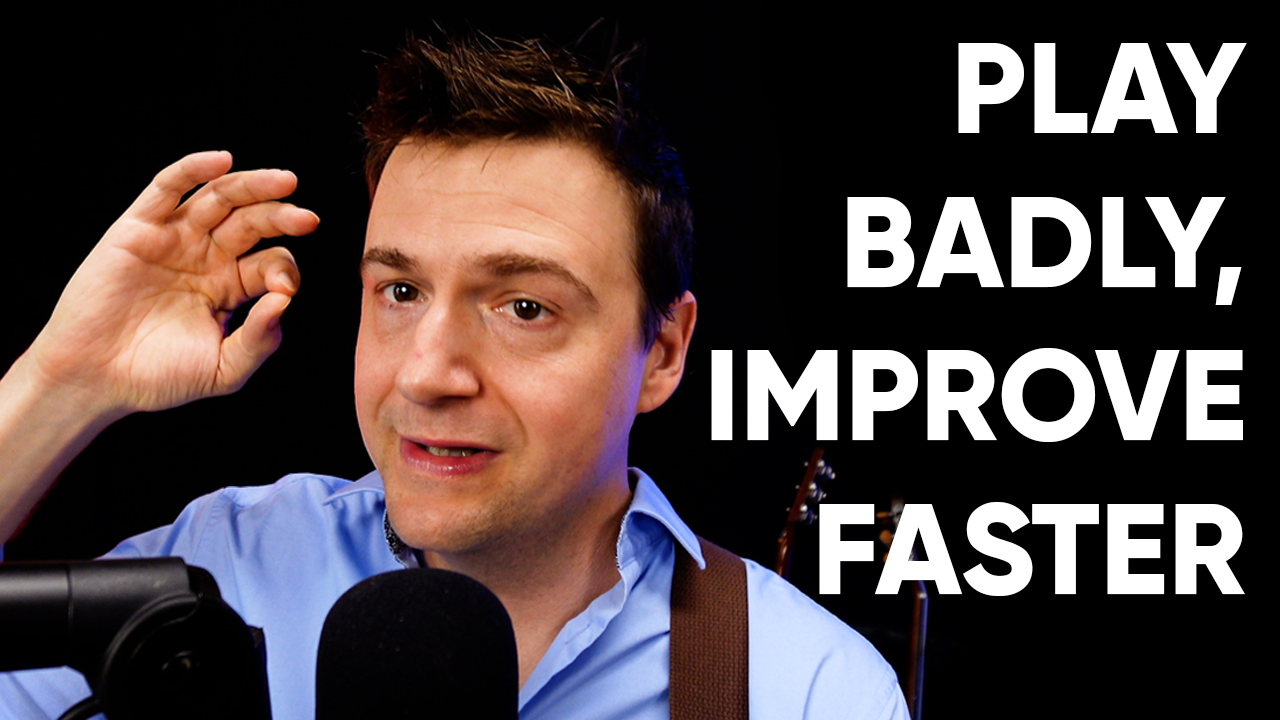
Today, I want to talk about the psychology of the "Inner Critic" and why learning to play "badly" might actually be the breakthrough your playing needs.
The "All-or-Nothing" Mindset
Many guitarists suffer from what psychologists call dichotomous thinking. In your head, a solo is either "perfect" or "garbage." There is no middle ground.
When you practice with this mindset, you aren’t training your musicality; you’re training your anxiety. Jazz is a language of flow and conversation. If you’re constantly editing your sentences while you’re speaking them, you’ll end up stuttering.
The Science of "Flow"
To really play jazz, you need to enter what's known as the Flow State. This is a mental state where your conscious, critical brain (the part that worries about wrong notes) takes a backseat to your subconscious, creative brain.
If your "Inner Critic" is too loud, you stay stuck in the "Anxiety" zone. To get into the flow, you have to give yourself permission to fail.
How to Practice "Permission"
So, how do we fix this? We have to trick the brain into letting go. Try these three Psychology Hacks during your next practice session:
- 1. The "Keep Going" Rule: Set a backing track. No matter what mistake you make—even if you play a B natural over a Bb7 chord—do not stop. Incorporate the "wrong" note. Resolve it. Make it look like you meant it. This trains your brain to prioritize recovery over perfection.
- 2. Limit Your Choices: Perfectionism often comes from "Option Paralysis." Limit yourself to only 3 notes for an entire chorus. When you remove the pressure to play "the best" line, you start focusing on rhythm and feel.
- 3. Record and Walk Away: Record your improvisation, but do not listen to it immediately. Wait 24 hours. When you listen back with "fresh ears," you’ll realize that the mistakes you thought were catastrophic are actually barely noticeable—and the parts you liked are often better than you remembered.
The Goal: Musical Honesty
"I hit a lot of wrong notes, I just make 'em right." — Joe Pass
Jazz isn't about being a robot. It’s about being human. Your listeners don't want a flawless MIDI performance; they want to hear your struggle, your resolution, and your soul.
Stop trying to play a "perfect" solo and start trying to play an honest one.
Hit the woodshed, let the mistakes happen, and as always...
Practice well, and I’ll see you soon!
Marc-Andre Seguin
JazzGuitarLessons.net
What’s your take?
What’s the biggest mental hurdle you face when soloing? I’d love to help you work through it.
LIKED THIS LESSON? HERE’S THE ROADMAP.
The Pinnacle Method shows you what to practice, and in what order, to start playing real standards. Free, and short on purpose.
Written by